It appears that the sentences in Wallace Budge’s (EAWB) Egyptian Language, pp 238-9 come from the Papyrus of Ani, and form part of the Book of the Dead. On the surface this would seem to be a not especially cheerful topic to modern Western thinking, but the sentences are free of anything gruesome or dismal, although the translations of them are enigmatic indeed. There is a chasm between when the text was compiled and the present, and the sorts of things being talked about in those far-off times might well have been different. But this passage is mostly about going through doorways, which would appear to be straightforward.
Here is page 238. At this stage just give it a quick glance:
EAWB: 238

Now let us look at various lines in detail.
EAWB:238:2
The first of these is the second line on the page above:

The three little boxes below show Wallace Budge's transcription, JMS's easy-to-read equivalent transcription, and JMS's word-for-word translation.
mer māåi årek āq ḥer
|
mer mayi ireq aq Her
|
canal // come / in relation to thee [?] / enter / at
|
The initial <water> en has been ignored, forming part of the previous line as a past tense marker. The portion of interest is ‘Come then pass in over ...’
Puzzles begin at once.
1. EAWB gives ‘then’ for :


in relation to thee
Gardiner, however, sees this as a preposition+pronoun (‘as to thee’), which JMS translates as ‘in relation to thee’.
2. Next, for <cormorant slope legs> EAWB gives ‘Come then pass in over ...’. But this same group he translates in different ways, including 'enter':
 |
 |
EAWB:238:2.5
|
EAWB:238:5.1, 239:1.3, 239:5.2
|
As shown in the analysis line above, your amateur researcher JMS has also opted for ‘enter’.
In each case being looked at, a JMS idiomatic translation is suggested in blue type:
... canal.
Come, you, before me enter at ...
EAWB:238:3
There is little to quibble over in the next line:

sba pen en useXt ten net Maāti
|
sebA pen en weseKHet ten net mAyati
|
door / this / of / wide what is (hall) / thee / of / Maāti
|
‘Hall’ in the middle of the line, transcribed useXt by EAWB, has been rendered weseKHet by JMS. As usual with Ancient Egyptian (AE) words, weseKH has several meanings (‘collar’, ‘cup’ among them) but most notably ‘wide’. The -et suffix is the relative marker, so weseKH-et means ‘wide what is’, something that is wide. So weseKHet is used for ‘barge’, and also for ‘hall’, both wide things.
| (wsḫt: weseKH-et) | "barge" | wide what is [boat] | Faulkner Concise | [69:8] | <quail cloth string bun tub boat> |
| (wsḫt: weseKH-et) | "hall" | wide what is [hall] | EAWB | [242:6.2] | <quail cloth string bun tub hairy: tub&bun> |
The next word <bun water> ten is translated by EAWB as 'this', but JMS translates it as the 2sg pronoun ‘thy’ (thee-of), or ‘your’.
... this door of your hall of Maāti ...
EAWB:238:4

åu - k reX - œ´å - n enen (i.e., ån) ṭā - å
|
iwu-k reKH-tji en enen (i.e., an) da-yi
|
be / thou / know will us-all // not / permit I
|
There is little to quibble over or remark on in this line.
... it's like this: you will know us.
I (will) not let you ...
EAWB:238:5

āq - k ḥer - å ån ben¬´s en
|
aq-ek Hera an benesh en
|
enter thou / before / in relation to me / by / bolt / of
|
Line 5, however, has several points of interest.
(a) It includes the ‘enter’ issue already dealt with in 238:2 above. In respect of this it is worth remarking that for verbs + pronouns written in hieroglyphs it is not possible to tell whether the case is nominative or accusative. That is to say, is this 238:5 instance ‘enter thee’ (accusative) or ‘thou enter’ (nominative). JMS opts for the latter, nominative, rather than EAWB’s accusative.
(b) The sentence also includes one of AE’s prepositions with multiple meanings, <face stroke> ḥer Her.

EAWB offers perhaps the principal meaning for Her, ‘over’ (or ‘upon’). But if we accept EAWB’s choice, then the sentence begins to sound like nonsense: ‘enter thee over me’? ‘over’? Really?
Possible meanings for Her found in the Nedj Nedj Database are:
over (upon, above), to, at, in, on, on account of, because, for, by, about, before, through, distant (far),
as well as nouns:
terror, Horus, rope, road, sky, face
and a verb:
prepare
In this instance JMS has opted for 'before'.
[c] Another multi-meaning preposition is <mouth> er, which JMS usually translates broadly as ‘in relation to’. And it seem possible that this is what applies here. Rather than Wallace Budge's single-word reading of the above 'over me' glyphs (Her-i), what might have in fact been intended possible was two words:
Her er-i
before / in relation to me
(d) With <reed water> in ‘saith’, the EAWB translation is beginning to look truly bizarre.

“Not will I let enter thee over me, saith the bolt of the door this, except thou sayest my name.”
This might be idiomatically rendered:
‘I will not let you enter over me’ says the bolt of this door unless you say my name’.
A door bolt talking? You enter over me? What is supposed to be going on?
But perhaps <reed bolt> does not mean ‘saith’— although in sometimes can indeed have this meaning as indicated by Gardiner in the examples below:
(ỉn⋅sn: in-sen)
|
"say they"
|
speak they-all
|
Gardiner
|
[348:436.33]
|
<reed water cloth water PLURAL>
|
(in: in)
|
"says"
|
speak
|
Gardiner
|
[554.1:1]
|
<reed water>
|
The AE word in also has the prepositional meaning ‘by’:
(in: in)
|
"by"
|
by
|
Col/Man
|
[9:7]
|
<reed water>
|
(ỉn: in)
|
"by"
|
by
|
Faulkner Concise
|
[22:3.1]
|
<reed water>
|
(in: in)
|
"by"
|
by
|
Gardiner
|
[553.2:12]
|
<reed water>
|
(in: in)
|
"by"
|
by
|
Kamrin
|
[250.2:12]
|
<reed water>
|
If in the present instance the meaning should be ‘by’, then the sentence could be viewed as reading, idiomatically:
“I would not let you enter before me by the bolt of this door unless you spoke my name.”
While this is still somewhat obscure (entering by the bolt?), it is not so quaint as the first version.
... thou enter before me by the bolt of ...
EAWB:238:6

sba pen [å]n - ås ¬´teṭ - nek ren - å
|
sebA pen nis djeden-ek ren-i
|
door / this / unless / speak did thou / name me-of
|
There is little to note in relation to this line. Perhaps the only item to remark on is the use of the past tense marker <water> en in:

Wallace Budge translates this in the present, but it is not. It is past tense:


... this door, unless you spoke my name.
INTERMISSION
As light relief, here are photographs of the temple at Luxor:

This is the great pylon at the front of the Luxor Temple, seen floodlit at night in 2009. There is one obelisk remaining today. Obelisks were made in pairs, and the second, which once stood to the right of the seated figure, is now in the Place de la Concorde, in Paris, having been a gift to France. The pedestal for it is still clearly visible. To enter the temple you walked between the huge seated pharaoh-figures, and between the towering obelisks.

Above is the same location somewhat earlier that day. It shows that the obelisks once stood either side of the great division between the two portions of the pylon.
Perhaps this entranceway was viewed as a ‘door’. It certainly led to the interior of the temple.
Below is a plan of the temple, viewed from the other direction. That is to say the plan has to be turned the other way round, to match the direction of the photographs.

The plan comes from:
JMS has picked the pylon is out with a faint yellowish tint, and the obelisk with green. As can be seen, the huge temple extends far beyond the pylon.
Baines, John, and Jaromir Malek. 1984. Atlas of Ancient Egypt. Oxford: Equinox (Oxford) Ltd.
JMS has picked the pylon is out with a faint yellowish tint, and the obelisk with green. As can be seen, the huge temple extends far beyond the pylon.
Could it possibly be that a scene like this was being described in the text we have been looking at? For the first word on the next line is challenging: teKH, written tex by Wallace Budge.
EAWB:238:7

teX en bu maā ren - t
|
teKHen bu mAya ren-et
|
obelisk / place / true / name thee-of]
|
Wallace Budge (EAWB) translates it as 'Weight'.
But here we get far fetched again. ‘Weight of the place of right and truth’?
The database offers meanings for teKH: 'plumb-bob', 'inebriate', and 'oil'. This is not much help. Can we look at the glyphs in any other way?
While the <water> en sign following teKH often is indeed the preposition ‘of’ as denoted by EAWB, perhaps it might simply have been joined to teKH to make teKHen. After all, the sp;aces between the hieroglyph groups we are looking at here were introduced by EAWB to make it simple. In reality all the hieroglyphs ran one after the other without spacing or punctuation, interrupted only by new lines as the necessity arose.
Before we examine the tekhen possibility, what is the word for ‘weight’ in the database? We find it is not teKHen but deben:
(dbn: deben)
|
"deben-weight, of about 91 grammes"
|
weight
|
Gardiner
|
[602.2:5.32]
|
<clip-Z water stone>
|
The following are some of the database results for 'weight':

There are other examples, but already it can be clearly seen that the word for ‘weight’ is deben; not so different in sound from teKHen, but different nevertheless.
And now for tekhen. What has the database to say about that?
There are half a dozen entries for tekhen but only one stand-out meaning: ‘obelisk’. One of these entries follows:


tekhen: 'obelisk' — with an obelisk as the determinative at the end
Here is the actual database entry for teKHen for the 238:7 line in question, from Wallace Budge:
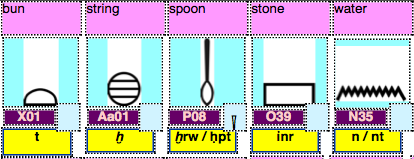
Interestingly, the second determinative (the fourth glyph above) in Wallace Budge’e example is ‘stone’. While an obelisk determinative would have been even more convincing, ‘stone’ is also indicative that the word might well be ‘obelisk’ that had been intended by the original writer (after all, obelisks were carved out of single stone monoliths), rather than the improbable Wallace Budge suggestion of ‘weight’.
The meaning of the sentence might then be something like:
‘Obelisk: the place of truth’ is your name.
Somewhat obscure still, but perhaps less than Wallace Budge’s interpretation seen above.
And that completes page 238.
PAGE 239
On the next page much of the foregoing is more or less repeated, except that the text refers to (door)posts, and to these being to the right and left.
Could it be that the ‘posts’ were in fact giant obelisks, which indeed originally stood to the right and left of a ‘door’, or entrance to a temple, through its pylon?
The remaining lines follow, in each case with a suggested revised translation below it in blue.
EAWB:239.1

ån ṭā - å āq - k ḥer - å ån
|
en di-i aq-ek Her-i in
|
not / permit I / thou enter / before / in relation to me / by
|
I will not let thee enter before me by ...
EAWB:239.2

ārit unem ent sba pen
|
arit imenet enet sebA pen
|
post / right / of / door / this
|
... the right post of this door ...
EAWB:239.3

[å]n-ås ¬´teṭ - nek ren - å ḥenku - nef
|
nis djeden-ek ren-i Henekun-ef
|
unless / speak did thou / name me-of // offer entity did he
|
JMS has translated EAWB's ḥenku as 'offer' rather than 'weigheth'. EAWB himself offers a different translation at the foot of the page in 239:7: 'Judge'. The database provides numerous examples of the word, meaning 'offer'.
... unless you say my name.
He did offer ...
EAWB:239.4

fat maāt ren - t enen (i. e., ån)
|
fAt mAyat ren-et enen (i. e., en)
|
carry what is / truth / name thee-of // not
|
... ‘carry [?] truth’ to be thy name.
Not ...
EAWB:239.5
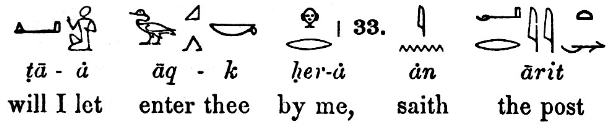
ṭā - å āq - k ḥer-å ån ārit
|
di-yi aq-ek Her-i in arit
|
permit I / enter thou / on account of me / by / post
|
I would not permit you to enter before me by the (post) ...
EAWB:239.6

åbet ent sba pen [å]n-ås ¬´teṭ - nek
|
iyabet net sebA pen nis djeden-ek
|
left / of / door / this / unless / speak did thou
|
... left-hand post of this door unless you spoke ...
EAWB:239.7

ren - å ḥenku en årp ren - t
|
ren-i Heneku en irep ren-et
|
name me-of // offer entity / of / wine / name thee-of
|
... my name.
‘Offer of (offered?) wine’ is your name.
CONCLUSION
How can one dare question such a monumental scholar as Wallace Budge, with his immense knowledge? And yet the glyphs themselves, with the aid of the Nedj Nedj Database, make it possible to conceive of alternative interpretations. And Wallace Budge himself interpreted the same word in different ways from time to time, as has been shown here and there above.
And is it such a wild leap to suppose that the door, the posts, and the entering might have been about a temple pylon with its attendant obelisks (posts) to the right and left of the gap forming the entranceway to the sanctuary?
Jeremy Steele
Saturday 3 August 2013
===================


